Preview
App
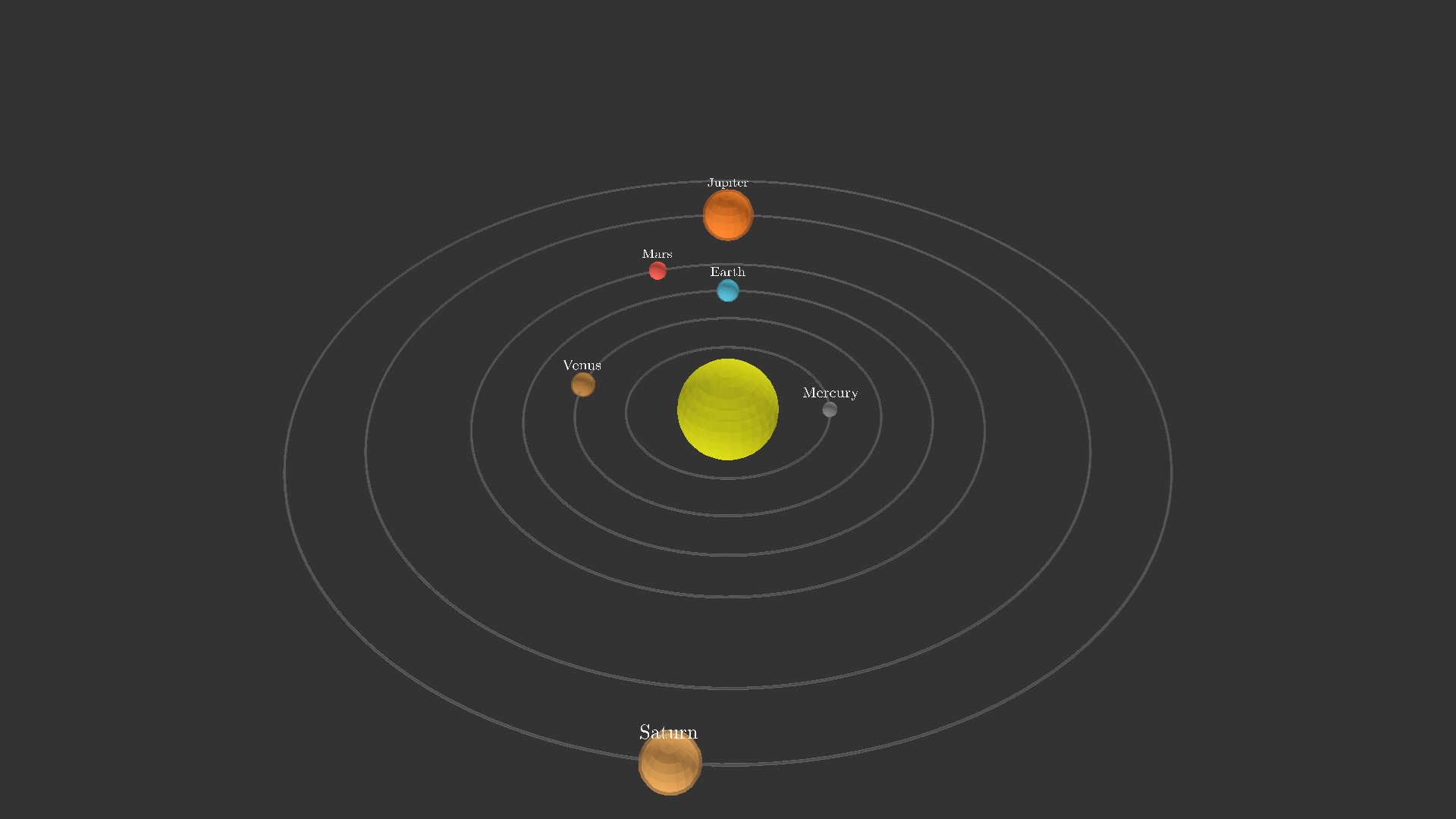
use std::f64::consts::{PI, TAU};
use ranim::{
color::palettes::manim,
glam::DVec3,
items::mesh::{Sphere, Surface},
prelude::*,
utils::rate_functions::{linear, smooth},
};
use ranim_anims::fading::FadingAnim;
use ranim_items::vitem::{VItem, text::TextItem};
const INTRO_SECS: f64 = 2.0;
const LABEL_DELAY_SECS: f64 = 1.0;
const LABEL_FADE_SECS: f64 = 1.0;
const ORBIT_SECS: f64 = 10.0;
const TOTAL_SECS: f64 = INTRO_SECS + ORBIT_SECS;
trait OrbitItem: Clone {
fn set_orbit_position(&mut self, position: DVec3);
}
impl OrbitItem for Transformed<Surface, Translation> {
fn set_orbit_position(&mut self, position: DVec3) {
self.transform = Translation(position);
}
}
impl OrbitItem for Vec<VItem> {
fn set_orbit_position(&mut self, position: DVec3) {
self.move_to(position);
}
}
struct OrbitMotion<T> {
src: T,
orbit_radius: f64,
initial_angle: f64,
total_angle: f64,
z: f64,
}
impl<T: OrbitItem> Eval for OrbitMotion<T> {
type Output = T;
fn eval_alpha(&self, alpha: f64) -> Self::Output {
let angle = self.initial_angle + self.total_angle * alpha;
let position = DVec3::new(
self.orbit_radius * angle.cos(),
self.orbit_radius * angle.sin(),
self.z,
);
let mut result = self.src.clone();
result.set_orbit_position(position);
result
}
}
struct PlanetData {
name: &'static str,
radius: f64,
orbit_radius: f64,
color: ranim::color::AlphaColor<ranim::color::Srgb>,
period: f64,
initial_angle: f64,
has_atmosphere: bool,
}
const PLANETS: &[PlanetData] = &[
PlanetData {
name: "Mercury",
radius: 0.3,
orbit_radius: 4.0,
color: manim::GREY_C,
period: 2.0,
initial_angle: 0.0,
has_atmosphere: false,
},
PlanetData {
name: "Venus",
radius: 0.5,
orbit_radius: 6.0,
color: manim::GOLD_E,
period: 3.0,
initial_angle: PI / 4.0,
has_atmosphere: true,
},
PlanetData {
name: "Earth",
radius: 0.5,
orbit_radius: 8.0,
color: manim::BLUE_C,
period: 4.0,
initial_angle: PI / 2.0,
has_atmosphere: true,
},
PlanetData {
name: "Mars",
radius: 0.4,
orbit_radius: 10.0,
color: manim::RED_C,
period: 5.0,
initial_angle: PI,
has_atmosphere: false,
},
PlanetData {
name: "Jupiter",
radius: 1.2,
orbit_radius: 14.0,
color: manim::ORANGE,
period: 8.0,
initial_angle: 3.0 * PI / 2.0,
has_atmosphere: true,
},
PlanetData {
name: "Saturn",
radius: 1.0,
orbit_radius: 17.0,
color: manim::GOLD_C,
period: 10.0,
initial_angle: TAU / 3.0,
has_atmosphere: true,
},
];
fn orbit<T: OrbitItem>(item: &mut T, planet: &PlanetData, z: f64) -> OrbitMotion<T> {
OrbitMotion {
src: item.clone(),
orbit_radius: planet.orbit_radius,
initial_angle: planet.initial_angle,
total_angle: TAU * (ORBIT_SECS / planet.period),
z,
}
.apply_to(item)
}
fn body_layer(mut surface: Transformed<Surface, Translation>, planet: &PlanetData) -> AnimSequence {
seq![
surface.show().with_duration(INTRO_SECS),
orbit(&mut surface, planet, 0.0)
.with_duration(ORBIT_SECS)
.with_rate_func(linear),
]
}
fn planet_label(planet: &PlanetData, position: DVec3) -> AnimSequence {
let label_z = planet.radius + 0.5;
let mut label = Vec::<VItem>::from(TextItem::new(planet.name, 0.6));
label
.move_to(position.with_z(label_z))
.with_origin(AabbPoint::CENTER, |items| {
items.rotate_on_x(30.0f64.to_radians()).discard()
});
let mut sequence = AnimSequence::new();
sequence
.forward(LABEL_DELAY_SECS)
.push(
label
.fade_in()
.with_duration(LABEL_FADE_SECS)
.with_rate_func(smooth),
)
.push(
orbit(&mut label, planet, label_z)
.with_duration(ORBIT_SECS)
.with_rate_func(linear),
);
sequence
}
fn planet_system(planet: &PlanetData) -> AnimStack {
let position = DVec3::new(
planet.orbit_radius * planet.initial_angle.cos(),
planet.orbit_radius * planet.initial_angle.sin(),
0.0,
);
let mut body_layers = AnimStack::new();
if planet.has_atmosphere {
let core = Surface::from(
Sphere::new(planet.radius * 0.9)
.with_resolution((20, 10))
.with_fill_color(planet.color.with_alpha(1.0)),
)
.transformed(Translation(position));
body_layers.push(body_layer(core, planet));
let atmosphere = Surface::from(
Sphere::new(planet.radius)
.with_resolution((20, 10))
.with_fill_color(planet.color.with_alpha(0.3)),
)
.with_smooth_normals()
.transformed(Translation(position));
body_layers.push(body_layer(atmosphere, planet));
} else {
let surface = Surface::from(
Sphere::new(planet.radius)
.with_resolution((20, 10))
.with_fill_color(planet.color.with_alpha(1.0)),
)
.with_smooth_normals()
.transformed(Translation(position));
body_layers.push(body_layer(surface, planet));
}
stack![body_layers, planet_label(planet, position)]
}
fn orbit_ring(planet: &PlanetData) -> AnimSequence {
let major_radius = planet.orbit_radius;
let minor_radius = 0.05;
let mut ring = Surface::from_uv_func(
move |u, v| {
let u_angle = u * TAU;
let v_angle = v * TAU;
DVec3::new(
(major_radius + minor_radius * v_angle.cos()) * u_angle.cos(),
(major_radius + minor_radius * v_angle.cos()) * u_angle.sin(),
minor_radius * v_angle.sin(),
)
},
(0.0, 1.0),
(0.0, 1.0),
(128, 16),
);
let color = manim::GREY_C.with_alpha(0.3);
ring.vertex_colors = vec![color; ring.vertices.len()];
let mut sequence = seq![ring.fade_in().with_duration(1.0).with_rate_func(smooth),];
sequence.hold_to(TOTAL_SECS);
sequence
}
fn orbit_rings() -> AnimStack {
let mut rings = AnimStack::new();
for planet in PLANETS {
rings.push(orbit_ring(planet));
}
rings
}
fn planetary_systems() -> AnimStack {
let mut planets = AnimStack::new();
for planet in PLANETS {
planets.push(planet_system(planet));
}
planets
}
#[scene]
#[wasm_demo_doc]
#[output(dir = "./output/solar_system")]
fn solar_system(r: &mut RanimScene) {
let phi = 50.0f64.to_radians();
let theta = -PI / 2.0;
let distance = 60.0;
let mut camera = CameraFrame::from_spherical(phi, theta, distance);
camera.fovy = 30.0f64.to_radians();
let sun = Surface::from(
Sphere::new(2.0)
.with_resolution((30, 15))
.with_fill_color(manim::YELLOW_C.with_alpha(0.5)),
);
r.play(camera.show().with_duration(TOTAL_SECS));
r.play(stack![
sun.show().with_duration(TOTAL_SECS),
orbit_rings(),
planetary_systems(),
]);
r.insert_time_mark(6.0, TimeMark::Capture("preview.png".to_owned()));
}